Made for One: How Made-to-Order Quietly Won Back the Discerning Man

There is a particular kind of luxury that no amount of money can buy off a shelf: the thing made for you and no one else. Not monogrammed after the fact, not selected from a wall of identical boxes, but built from a blank starting point around your foot, your taste, your idea of how a shoe should look at the end of a long dinner. For most of the twentieth century this was the private province of a shrinking club — Savile Row tailors, Neapolitan cutters, a handful of Northampton lasting rooms. Today it is quietly becoming the thing serious dressers want most.
Call it a correction. After two decades in which luxury meant scale, logos and speed — the same sneaker in forty cities, the same monogram on a million bags — the pendulum has swung toward the singular. The most interesting men I know are no longer asking which brand. They're asking who made it, and whether they can have a say in how.
The Long Memory of Bespoke
Made-to-order is not new; it is simply how clothes were made before industry got involved. A gentleman in 1890 did not walk into a shop and buy a suit. He was measured, and a suit was cut for him. Savile Row built an empire on the idea, and houses like Anderson & Sheppard turned the drape cut into a language spoken in inches and preferences. In Naples, the tailoring tradition took the same principle and made it looser, softer, more sunlit — the unstructured shoulder of Rubinacci and its heirs became a kind of anti-uniform, luxury that whispered.
Shoes followed the same arc. In the lasting rooms of Northampton and the ateliers of Paris, the finest footwear was cut to a wooden last shaped for a single client. John Lobb's bespoke workshop, the benches of Edward Green and Gaziano & Girling — these are institutions built on the radical notion that a shoe should be made for a foot, not a size chart. The industrialization of the twentieth century made shoes cheaper and more available, and in doing so quietly convinced us that ready-made was the natural order of things. It never was. It was a compromise we agreed to forget.

Why the Idea Is Back
Three things brought made-to-order out of the archive. The first is fatigue. When everyone can buy the same it-item with a tap, exclusivity stops meaning anything, and the men who once chased logos start looking for something the algorithm can't recommend to a thousand others. The second is craft-consciousness — a generation that watches sourdough documentaries and knows the difference between machine-welted and hand-welted has developed an appetite for provenance. The third, less romantically, is technology: the same digital tools that flattened luxury into e-commerce also made it possible to configure, preview and order something personal without setting foot in an atelier.
The result is a middle ground that barely existed a generation ago. Full bespoke — the multi-fitting, individually-lasted grail — remains rare and expensive. Ready-to-wear is everywhere. But between them sits made-to-order: you begin with a proven pattern and a house's craft, and you make the decisions that matter. The leather. The color. The finish. The personality.
The Feet Are the Right Place to Start
If you're going to commission one made-to-order thing, start with shoes. The logic is simple: shoes are the hardest part of an outfit to fake and the easiest place for personality to register. A good suit can be very good off the peg. A shoe with a genuinely bespoke finish — a hand-painted patina, a color mixed rather than chosen — announces intention in a way nothing else in a man's wardrobe does.
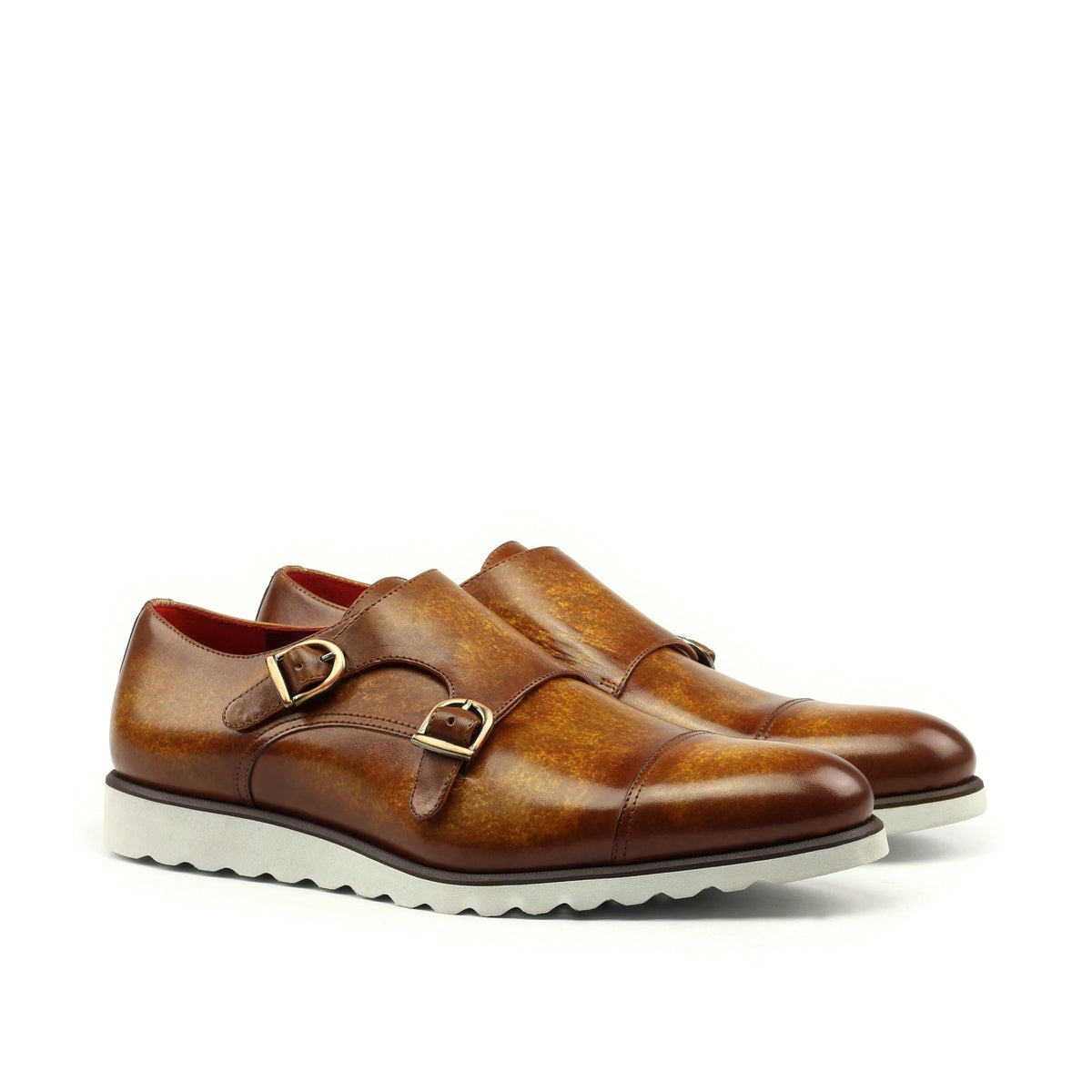
This is where the art of patina earns its reputation. The technique, refined into a signature by Olga Berluti in the 1980s and now practiced by ateliers around the world, starts with untreated crust leather — a hide left uncolored so it can absorb dye like watercolor paper absorbs pigment. From there the shoe is built up in layers: light to dark, cool to warm, until the surface has depth no factory finish can imitate. Two men can order the identical model and end up with shoes that could never be confused. That is the entire point.
A double monk is the ideal canvas for it — enough surface to show gradation, enough architecture to carry the drama. Something like the Dilya Double Monk Patina II demonstrates the appeal of the made-to-order approach: a classic silhouette rendered in hand-finished Italian crust leather, where the color isn't a stock option so much as a decision.
What You're Actually Buying
The temptation with anything personalized is to over-engineer it — to treat the freedom as a dare and end up with something that photographs loudly and wears awkwardly. The men who do made-to-order well tend to follow a discipline that looks a lot like restraint:
- Buy the classic shape, personalize the finish. A wholecut, an oxford, a monk — proven silhouettes take individuality without becoming costume.
- Let the leather do the talking. A subtle patina reads as depth from across a room and as artistry up close; a garish one only ever reads as garish.
- Think about the second wearing, not just the first. The best made-to-order pieces are the ones you reach for on a Tuesday, not the ones you're afraid to scuff.
There is also room for genuine expression, and made-to-order is where the more adventurous ideas belong. Consider the current appetite for calligraphy and text on footwear — a script wholecut like the Script Two Patina Wholecut II takes the seamless, single-piece drama of the wholecut and layers it with a graphic, hand-worked patina. It is not a shoe for everyone, which is precisely what makes it a made-to-order proposition rather than a shelf one.
The Slower Pleasure
What made-to-order asks of you is the one thing modern luxury has trained us to avoid: patience. You cannot have it now. You have to decide what you want, hand the idea to someone with the skill to realize it, and wait while it is made. In exchange you get something the checkout culture forgot to sell — the pleasure of anticipation, and an object that carries a fingerprint of your own judgment.
That is the quiet victory of the movement. It isn't loud, it doesn't trend, and it will never move the volume that a viral sneaker moves. But for the man who has already bought the obvious things and found them wanting, made-to-order offers the last real luxury: the chance to own something that was, in the truest sense, made for one.

اترك تعليقًا
This site is protected by hCaptcha and the hCaptcha Privacy Policy and Terms of Service apply.