Articolo: Lo Stivale Chelsea: Duecento Anni dalla Scuderia alla Prima Fila
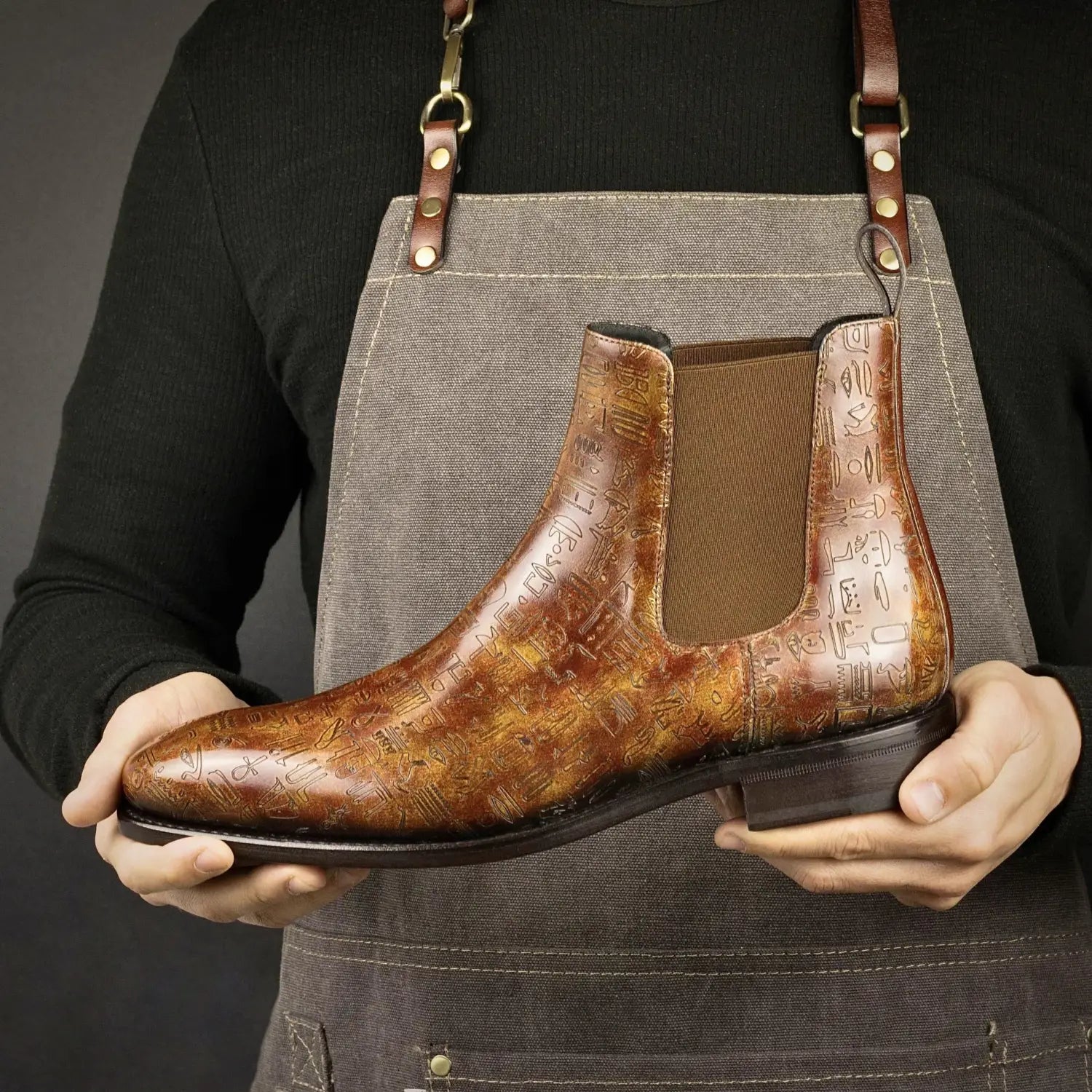
Lo Stivale Chelsea: Duecento Anni dalla Scuderia alla Prima Fila

Every so often a garment appears that seems to have been designed by consensus rather than a person — so obvious in hindsight that you assume it was always there. The white T-shirt. The trench coat. The Chelsea boot belongs to that rare company. A close-fitting ankle boot with no laces, no buckles and a stretchy elastic panel at each side, it is one of the few pieces of menswear that has looked equally correct on a Victorian horsewoman, a 1960s guitarist and a man hailing a cab outside a Milan hotel this morning. That is not an accident. It is the reward of a very good idea, executed early and rarely improved upon.
An invention born of frustration
The story begins, as a surprising amount of British style does, with Queen Victoria and a practical problem. Boots of the 1830s and 1840s laced or buttoned, which made them slow to put on and — for a monarch who liked to ride — a genuine nuisance. Her bootmaker, J. Sparkes-Hall, took advantage of a new material: vulcanised rubber, which Charles Goodyear had recently made stable enough to be useful. In 1851 Sparkes-Hall patented an ankle boot with vulcanised elastic gussets that allowed it to be pulled on and off in seconds while still hugging the foot. He proudly noted that the Queen walked in them daily. The "paddock boot" or "jodhpur boot," as it was then known, was equestrian equipment: neat, secure, and easy to clean of stable mud.
For roughly a century it stayed in that lane — a countryside and riding shoe, sensible and unremarkable. What transformed it was not a designer but a postcode.

How a boot got its name
By the late 1950s and early 1960s, the King's Road in Chelsea had become the laboratory of young British style. The area's boutiques and coffee bars drew artists, musicians and the loosely defined "Chelsea Set," and the trim elastic-sided boot — restyled with a sharper toe and a higher, sometimes Cuban, heel — became their unofficial footwear. It was slim, modern and utterly at odds with the heavy brogues of their fathers. Somewhere in this scene the boot acquired the name it still carries.
Then came the amplification. The Beatles, dressed by London tailors and shod in a Cuban-heeled variant made by the theatrical shoemaker Anello & Davide, put the silhouette on stages and album sleeves around the world; the style is still widely called the "Beatle boot." The Rolling Stones wore it looser and dirtier. Mod culture adopted it as a uniform. In a few short years the Chelsea boot completed one of fashion's most dramatic migrations — from the mews to the music charts — without changing its basic anatomy at all.

Why it never really left
Most trend pieces end with a fall from grace. The Chelsea boot doesn't have one, only quieter decades. It resurfaced with Britpop in the 1990s, was reissued as a luxury staple by houses from Saint Laurent to Common Projects in the 2010s, and has become the default alternative to a sneaker for men who want something with a little more intent. Its genius is structural: because there is no lacing or hardware, the eye reads an unbroken line from trouser to floor. That line lengthens the leg, dresses up denim and dresses down tailoring. It is, in the truest sense, a bridge shoe.
It is also honest about its materials, which is why the choice between leather and suede matters more here than on almost any other boot.
Leather or suede — a genuine fork in the road
Polished calf leather is the formal reading. A dark brown or black Chelsea in smooth leather sits comfortably under a suit and reads as a considered, grown-up substitute for an oxford in winter. A warmer tan, meanwhile, is the great weekend diplomat — happy with raw denim, flannel trousers or unstructured tailoring, and only improving as it takes on the faint creasing and deepening colour that good leather earns with wear.

Suede is the other temperament entirely — softer, quieter, and to many eyes more elegant precisely because it refuses to gleam. A navy or dark-tobacco suede Chelsea has a matte depth that flatters knitwear and corduroy in a way patent leather never could. The trade-off is care: suede wants a brush, a protector spray and a firm no to rainstorms. Treated with a little respect, it ages beautifully.

This is where a made-to-order house earns its keep. When a maker like Que Shebley finishes the boot by hand in Italian crust leather — the pale, untreated hide that patina artists colour by hand — you can specify the exact depth of brown or the particular smoke of a navy suede, rather than accepting whatever the shelf offers. For a shoe whose whole appeal is the clean, uninterrupted line, getting the colour and the fit right is not vanity; it is the entire point.
Getting it right: a short buyer's guide
- Mind the toe. A slightly rounded or gently tapered toe ages far better than an exaggerated point, which dates a boot instantly. Aim for the middle.
- Watch the elastic. The gusset should be discreet and close in colour to the leather, and the top opening should sit snugly at the ankle. A gaping panel ruins the silhouette and the shoe.
- Cover the ankle, break the hem. The boot should meet a trouser that just kisses the top of it, or a jean cropped or cuffed to reveal a sliver of shaft. Never let fabric bunch over it.
- Buy for the life you have. Smooth leather for suits and city days; suede for tailoring's off-duty hours. If you can only own one, a dark brown leather pair is the most versatile boot you will ever buy.
- Fit close. With no laces to adjust, the Chelsea relies entirely on last shape and elastic tension. Try before you commit, or buy from a maker who will guide the sizing.
The quiet argument it makes
What keeps the Chelsea boot relevant is not novelty — there is none left to wring from a 170-year-old design — but restraint. In a menswear culture that increasingly rewards volume and logos, here is a shoe that solved its problem in 1851 and has spent every decade since being useful. It flattered a queen who wanted to ride without fuss, and it flattered four young men who wanted to look like the future. It will, in all likelihood, flatter you on a grey Tuesday when nothing else in the wardrobe feels right.
That is the mark of real design: it stops asking for attention and simply becomes the answer. The Chelsea boot has been the answer for two centuries. It is in no hurry to stop.


Lascia un commento
Questo sito è protetto da hCaptcha e applica le Norme sulla privacy e i Termini di servizio di hCaptcha.