The Fairway Was Always a Runway: A Short History of the Golf Shoe

There is a persistent myth that golf clothing has always been dowdy — a wardrobe of synthetic polos and shoes that look like orthopaedic appliances. It is a slander, and a recent one. For most of the twentieth century, the golf course was among the best-dressed places a man could stand, and the shoe on his foot was doing some of the hardest, most interesting design work in menswear. Long before the trainer became acceptable in a boardroom, the golf shoe was already solving the same problem: how to make something built for movement look like something built for taste.
The story starts, as so many good stories in menswear do, in Scotland. Golfers on the links at St Andrews and Musselburgh in the nineteenth century played in whatever stout boots they owned, and when the ground was wet — which, this being Scotland, was always — they hammered hobnails and metal studs into the soles for grip. The spiked golf shoe was not invented so much as improvised, a country-shoe modification that eventually became a category of its own. By the Edwardian era, bootmakers were selling purpose-built spiked footwear, and the game had its first true piece of specialist kit.
The Saddle Shoe, and the Birth of the Two-Tone Fairway
The next leap was American and, crucially, aesthetic. In 1906 the sporting-goods firm Spalding introduced a shoe with a reinforcing band of leather stitched across the instep — the "saddle" — originally intended to add strength for racquet sports. Golfers adopted it, and the two-tone saddle shoe became the defining look of the interwar links: white buckskin with a contrasting saddle in tan or black, often finished with a fringed kiltie tongue flapping over the laces. It was practical and it was pure showmanship, and the men who wore it knew the difference.
Consider Walter Hagen, the first great professional showman of golf, who arrived at tournaments in the 1920s dressed with a deliberate, needling elegance — silk shirts, sharp trousers, immaculate shoes — partly to unsettle his amateur opponents, who still regarded professionals as tradesmen. Hagen understood that how you looked walking to the first tee was itself a form of pressure. A decade later the plus-four — the ballooning knickerbocker that ended below the knee — turned the golfer's leg into a display case, and the two-tone shoe was the punctuation mark at the bottom of it. This was the F. Scott Fitzgerald era of the game, the world of country clubs and the fairways that flicker through the background of *The Great Gatsby*: leisure as performance.

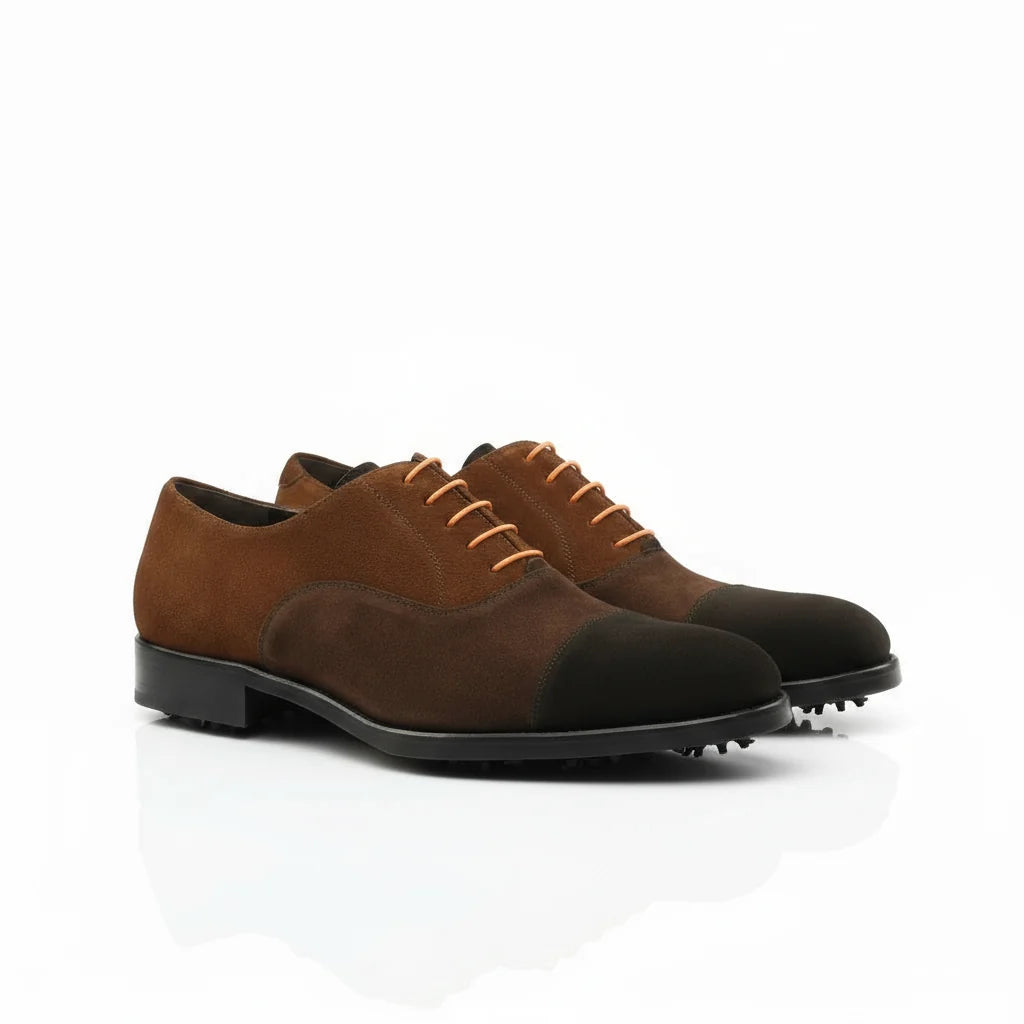
The saddle silhouette has never really left. It survives on the fairway, but it also crossed over into everyday dress — the co-respondent and the campus classic both descend from it. What makes a modern saddle golf shoe worth attention is the same thing that made the original one great: the interplay of colours across a low, elegant last, the visual rhythm of a contrast band breaking up the vamp. Done in hand-finished leather rather than glossy plastic, it reads less like sports equipment and more like something you'd happily wear off the course to a summer lunch.

The Brogue Goes to Work on Grass
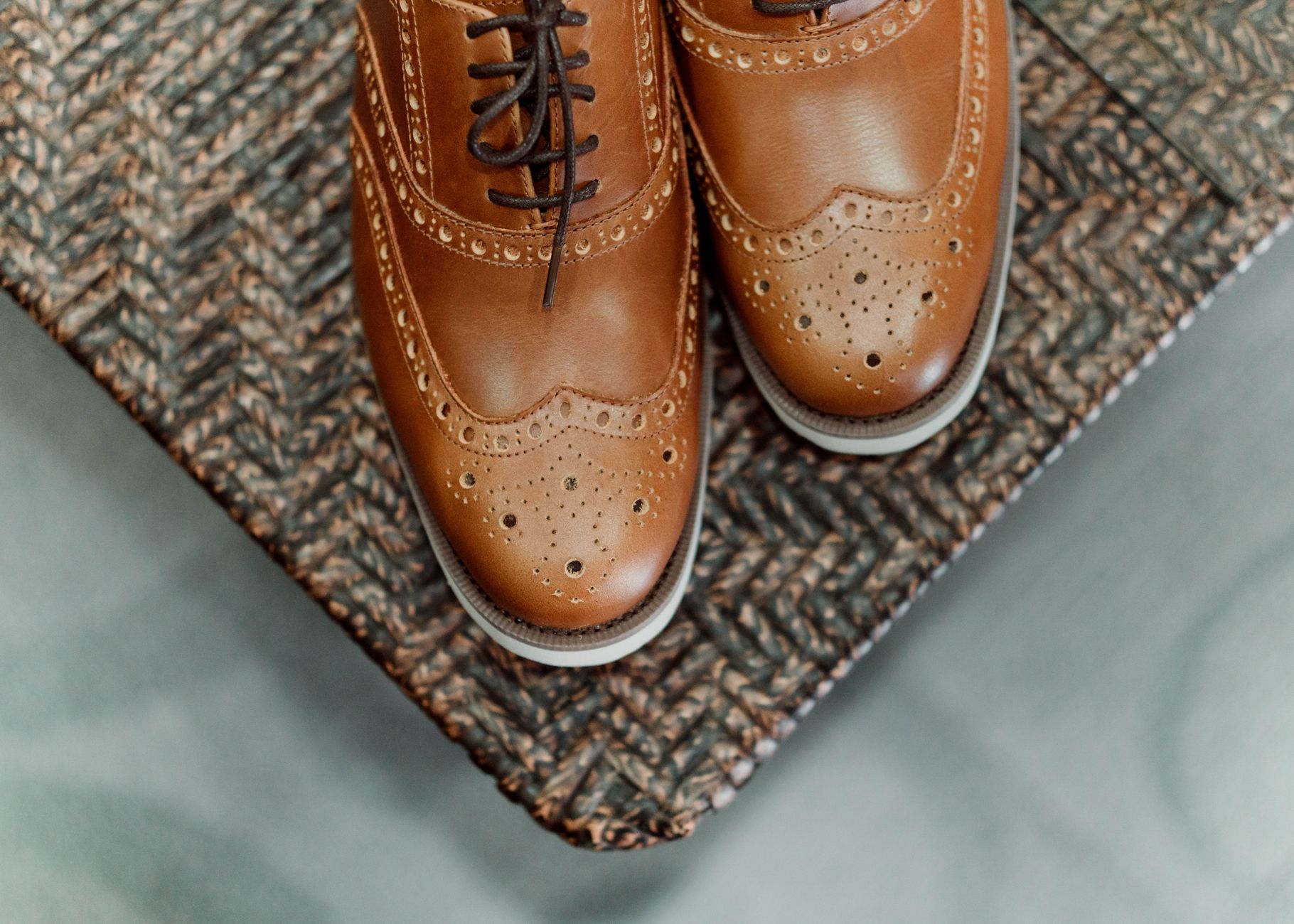
If the saddle shoe was the flamboyant cousin, the wingtip brogue was the golf shoe's serious side. The perforated cap and pinked edges of the full brogue were originally functional — the holes in traditional Irish and Scottish country brogues let water drain out after tramping through bogs. That is a nearly perfect origin story for a golf shoe, and it's no accident that the brogue became the game's default dress code for decades. Firms like FootJoy built empires on the spiked wingtip, and the look was so dominant that for most of the century "golf shoe" and "brogue" were close to synonymous.
The pleasure of a brogued golf shoe is that it borrows the full grammar of a proper dress shoe — the wingtip, the medallion, the broguing that catches light along the toe — and then quietly re-engineers the sole for grip. Worn today with tailored trousers rather than plus-fours, a well-made version photographs beautifully, all texture and shadow.

The Spike Question
For most of the game's history, grip meant metal — steel spikes screwed into the sole, ferociously effective and murder on clubhouse floors and putting greens alike. The great shift came in the 1990s, when soft, plastic "alternative" spikes swept the sport; many courses banned metal outright to protect their greens. That change did more for golf-shoe design than any style trend, because it freed the shoe from having to be a brutal, purely functional object. Once you could walk off the eighteenth and straight into the bar without gouging the parquet, the golf shoe was allowed to look civilised.
That is the lineage behind the modern dress-leaning golf shoe: the plaid-and-leather oxford, the polished blucher, the styles that would not look out of place under a suit. If Payne Stewart's plus-fours and tam-o'-shanter were the last great flourish of golf-as-theatre in the 1980s and '90s, today's version is quieter but no less considered — a shoe that respects the traditions of St Andrews and the dress rooms of Augusta National without cosplaying them.

What the Golf Shoe Still Teaches
The reason all this matters beyond the fairway is that the golf shoe has always been menswear's most honest laboratory for a single question: can a functional shoe also be a beautiful one? Every debate now raging about luxury sneakers and "smart-casual" was settled, decades ago, on a golf course, by men who wanted grip, waterproofing, and a shoe handsome enough to be seen in at the club afterwards.
A few principles still hold, whether you play or simply admire the object:
- Leather ages better than plastic, on grass or off. A crust-leather upper that develops a patina will look richer in five years; a moulded synthetic shell will simply look older.
- The saddle and the brogue are timeless for a reason. Both were designed for function and survived on pure looks — the surest sign of good design.
- A great golf shoe should earn its keep in the clubhouse. If it can carry you from the last hole to lunch without looking like sports kit, it's doing its job.
It is telling that the best golf footwear now comes from the same craft tradition as proper dress shoes — hand-finished uppers, considered lasts, the option to choose your own colours and contrasts through made-to-order. The fairway, it turns out, was always a runway. The men in plus-fours simply had the confidence to admit it.

Laisser un commentaire
Ce site est protégé par hCaptcha, et la Politique de confidentialité et les Conditions de service de hCaptcha s’appliquent.