Borrowed, Never Returned: How Women Stole Menswear's Best Shoes

In 1932, Marlene Dietrich walked through Paris in a man's suit and, depending on which apocryphal version you believe, was either threatened with arrest or simply stared at until traffic slowed. Either way, the point landed. A woman in tailoring was not a novelty act; it was a declaration. And while the trousers and the wide-shouldered jacket got the headlines, the quieter revolution was happening at floor level. Because once a woman decides to wear a man's suit properly, she cannot finish it with a stiletto. She needs the shoe, too.
What followed is one of the great one-way migrations in fashion. Over roughly a century, women have raided the menswear canon — the loafer, the brogue, the monk, the horsebit slip-on — and absorbed those shoes so completely that we now forget they were ever borrowed. The men, meanwhile, never got them back. This is the story of the most successful theft in style, and why it keeps happening.
The tuxedo that changed everything
You cannot talk about women in menswear without arriving, eventually, at Yves Saint Laurent's Le Smoking in 1966 — the tuxedo cut for a woman, presented not as costume but as evening wear with intent. Helmut Newton's 1975 photograph of Le Smoking on a Paris side street, all shadow and cigarette smoke, did more for the idea than any runway. It made androgyny look expensive and, crucially, adult.
But Saint Laurent was building on ground already broken by braver, stranger women. Katharine Hepburn wore trousers so relentlessly that the studios eventually stopped fighting her. Coco Chanel had spent the 1920s stripping the corsetry out of womenswear and lifting silhouettes and fabrics — jersey, tweed, the flat two-tone slingback — straight from the male wardrobe and the sporting world. By the time Diane Keaton walked into Annie Hall in 1977 in a waistcoat, tie and men's trousers, the look had gone from scandal to sophistication in a single generation.
The through-line in all of it is ease. Menswear, for all its rules, was built around movement and comfort in a way womenswear historically was not. When a woman adopts a man's shoe, she is not just making a statement about gender; she is opting into a century of engineering designed to let a person actually walk.

The loafer's long crossover
No shoe crossed over more completely than the loafer. Its origins are a tangle of Norwegian farm slippers and American college campuses — the Bass Weejun landing in the 1930s, the Ivy League adopting it, the penny slot becoming folklore. It was a man's casual shoe, then a preppy uniform, then, quietly, everyone's.
Gucci accelerated the drift. When the house introduced its horsebit loafer in 1953, it created something that read as both louche and correct — a shoe you could wear with a suit or with nothing much at all. By the 1960s and '70s it was on the feet of men and women alike, a rare piece of luxury that refused to pick a lane. The horsebit loafer's genius was that it flattered a bare ankle and a trouser break equally, and it has never really left the conversation since.
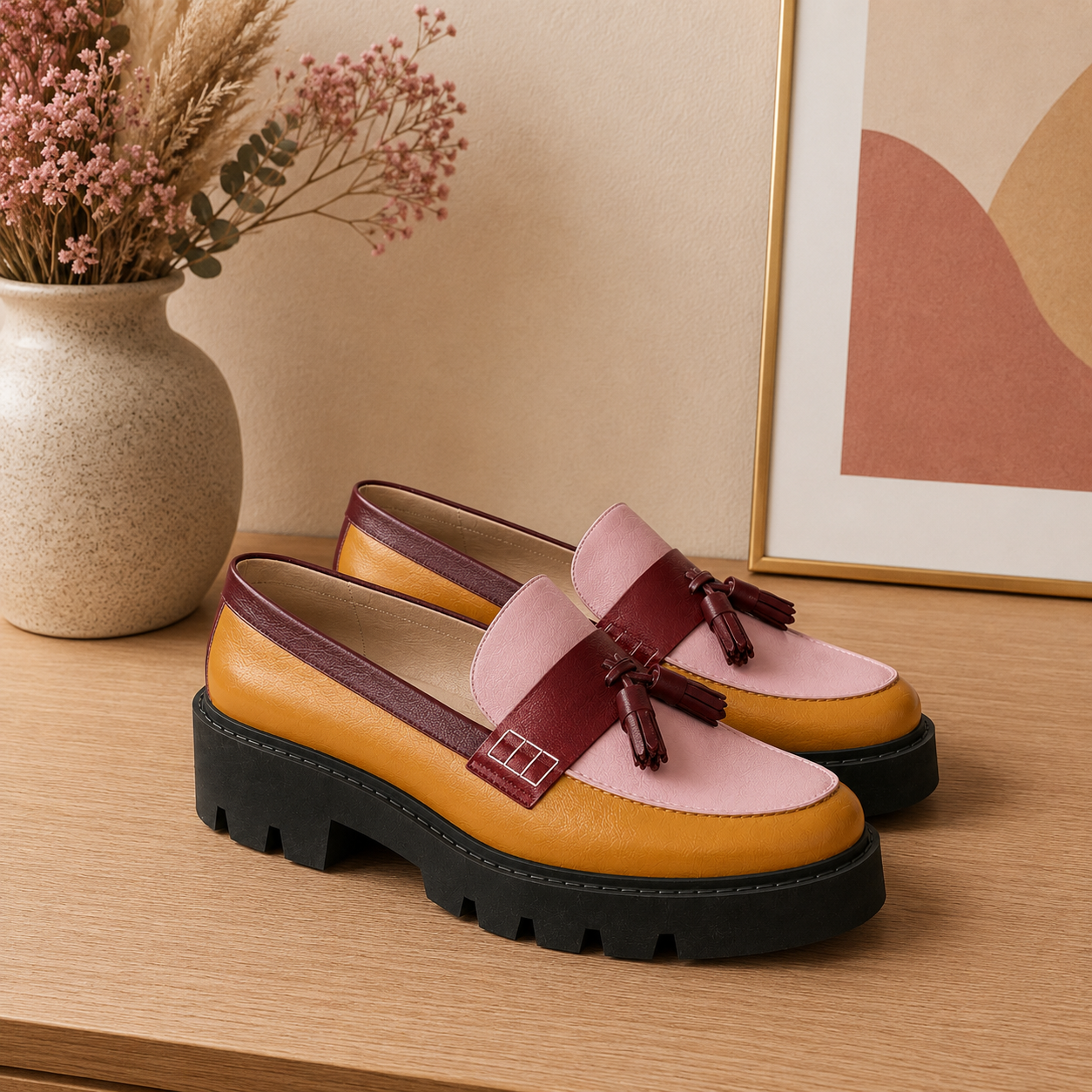
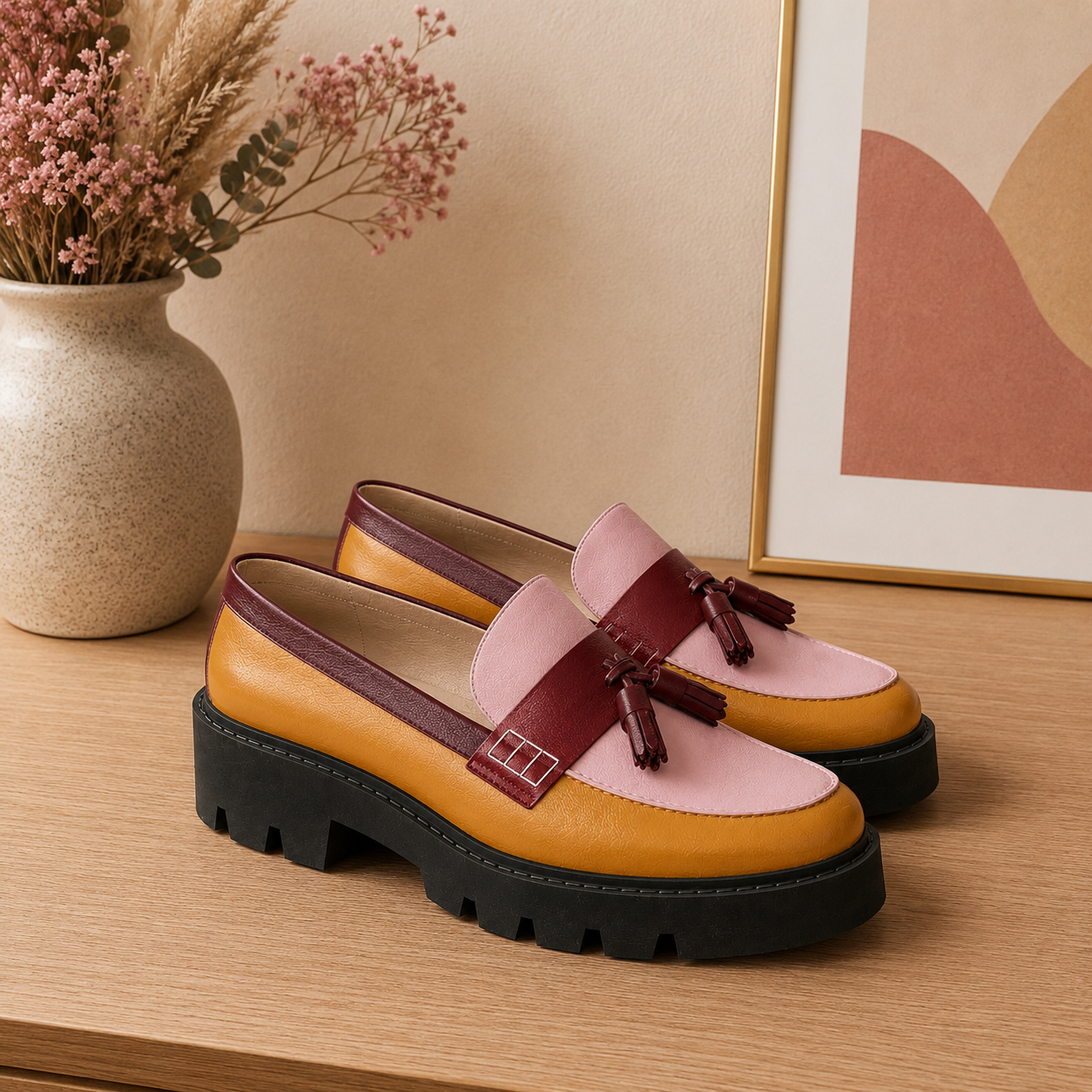
The tassel loafer took a slightly more academic route — a lawyerly, faintly Ivy shoe with a reputation for belonging to men who were sure of themselves. Which is precisely why it works so well when a woman wears it. The tassels, those absurd little flourishes, stop reading as fussy and start reading as wit. Worn with cropped tailored trousers and no socks, a tassel loafer does the thing the whole tradition promises: it makes formality look effortless.

This is the register a shoe like Que Shebley's Farah Tassel Loafers plays in — a menswear silhouette rendered with hand-finished Italian crust leather, built to take a patina rather than hide behind a coat of pigment. Crust leather is the connoisseur's material precisely because it is finished by hand after the shoe is made, which means the colour has depth and the shoe ages like a good watch strap: better, not worse.

Why the plain loafer endures
Strip away the tassels and the horsebit and you are left with the purest version of the idea: the clean-lined loafer, unornamented, letting the leather and the last do all the talking. It is the shoe equivalent of a white shirt, and it has become the modern woman's most reliable answer to the question of what to wear when the occasion is ambiguous — which, increasingly, every occasion is.

The plain loafer is also the great equaliser of a wardrobe. It pairs as naturally with a slouchy suit as it does with wide denim or a midi skirt, and it does the rare trick of looking deliberate in every one of those contexts. Style commentators from Alexa Chung to the Milanese street-style set have spent the last decade proving the point, but the truth is older than any of them: a well-made flat is never wrong.
The counterpoint, and why borrowing works both ways
None of this is an argument that women abandoned femininity at the shoe rack. The best-dressed among them understood that borrowing from menswear works precisely because it is played against something softer. Bianca Jagger married a white Le Smoking-style suit with a distinctly glamorous ease. The tension is the whole point.
Which is why the slingback endures alongside the loafer rather than in opposition to it. Where the loafer is grounded and easy, the slingback — an open heel, a hint of movement, a shoe that half-commits — is the flirtatious counterargument. A pair like the Amira Slingback Pumps belongs to a different lineage entirely, closer to Chanel's two-tone than to any men's brogue, and a wardrobe with both is a wardrobe that understands range.

What ties the whole story together is craft rather than gender. The reason menswear's shoes travelled so well is that they were built to a standard — good leather, considered lasts, construction meant to last decades. When that standard is offered on a made-to-order basis, in leathers you can watch develop their own character over years, the old distinction between his and hers starts to look like exactly what it was: a marketing convenience, not a rule.
Dietrich understood that in 1932. She took the best shoe in the room and simply declined to give it back. Nearly a century later, the smart money is still on the woman who does the same.

Deja un comentario
Este sitio está protegido por hCaptcha y se aplican la Política de privacidad de hCaptcha y los Términos del servicio.