
Dots and Quills: The Strange, Luxurious Life of Ostrich Leather
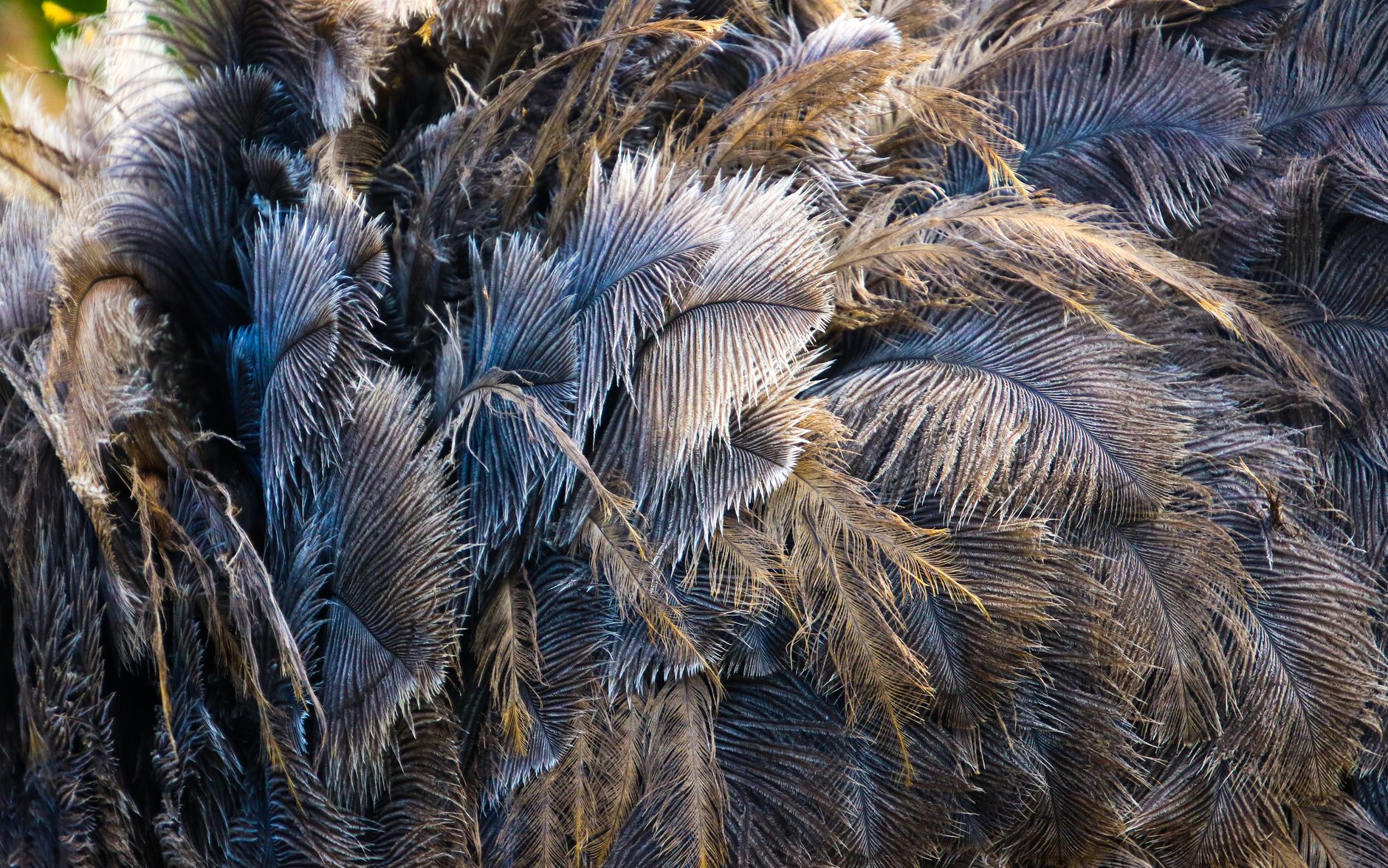
Run a fingertip across a good piece of ostrich leather and you feel something no calfskin can offer: a soft, irregular braille of raised bumps, each one the follicle where a feather once grew. Collectors call it the crown, the premium center-back section studded with these quill marks. Everyone else just calls it "that bumpy leather," usually while trying to decide whether it's the height of taste or the depths of it.
The honest answer is that ostrich has been both, often within the same decade. Few materials in the menswear canon have swung so violently between vulgar and venerable. To understand why it deserves a second look, you have to start where the birds do—on a dry, scrubby plateau in the Southern Hemisphere, and in a fashion mania that once made feathers worth more than gold by weight.
The feather boom that built a town
Long before anyone thought of the skin, it was the plumes that made fortunes. In the late nineteenth and early twentieth centuries, ostrich feathers decorated the hats of Belle Époque Paris, the fans of Edwardian London, and the costumes of every music hall worth the name. The epicenter was the Little Karoo region around Oudtshoorn, South Africa, where so-called "feather barons" built extravagant sandstone "feather palaces" on the proceeds. At its peak, ostrich plumage ranked among South Africa's most valuable exports, trailing only gold, diamonds, and wool.
Then fashion did what fashion always does. The open-topped motorcar made a tower of feathers impractical, the First World War hollowed out the luxury market, and the great plume bubble burst almost overnight. What survived was the bird itself, and a farming infrastructure that gradually pivoted from feathers to meat and, crucially, to hide. The leather that had been a byproduct became the prize.

Why the bumps matter
The thing most people get wrong about ostrich is that the quill-follicle pattern covers the whole skin. It doesn't. Only the crown—roughly the center of the back—carries the dense, generous spread of bumps, and a single bird yields just one of them. That scarcity is why a full-quill ostrich piece commands a premium over the smoother leg leather (sold as "ostrich leg," with a scaly, almost reptilian grain) or the plainer side sections.
Beyond looks, there's substance. Ostrich is prized by tanners for a tensile strength and suppleness that belies its softness; the natural oils in the hide make it unusually resistant to cracking and drying, which is partly why vintage ostrich pieces so often outlive their owners. It takes dye beautifully, develops a deep, lived-in sheen with wear, and—unlike many exotics—stays pliable rather than stiffening into a shell. The bumps themselves flatten slightly and soften over years of handling, the way a good leather chair earns its character.

From flash to finesse
For a long stretch of the late twentieth century, ostrich carried baggage. It was the leather of the loud cowboy boot, the Vegas blazer, the briefcase that announced its owner before he'd entered the room. Houses like Hermès and Bottega Veneta quietly kept working with it at the top end, but in the popular imagination ostrich meant volume, not nuance.
That has flipped. The same shift that rehabilitated other exotics—a general move away from logos and toward materials you have to know to recognize—has been kind to ostrich. Done in a muted navy, a tobacco brown, or a dove grey, the quill pattern reads as texture rather than trophy. You notice it at conversational distance, not across a parking lot. It has become, improbably, a discreet luxury: the kind of detail that rewards the person wearing it more than the people looking.
The most interesting place that evolution is playing out is footwear—and specifically, the sneaker. For decades ostrich lived almost exclusively on formal boots and billfolds. Putting it on a low trainer is a genuinely modern idea, pairing the tactile richness of the hide with a silhouette built for Tuesday rather than a gala.

Que Shebley's Honovi trainer is a neat case study in the register ostrich now occupies. The quill texture does the talking, but the shape is unapologetically casual—worn with raw denim or a pair of drawstring trousers, it's the opposite of a status broadcast. It's the move of someone who has stopped trying to impress strangers and started buying for himself.
How to read a piece of ostrich
If you're shopping for it—boots, a wallet, a sneaker—a little literacy goes a long way. A few things worth knowing before you spend:
- Crown vs. leg. Full-quill crown leather, with its generous bumps, is the premium cut; ostrich leg has a smoother, scaled look and typically costs less. Neither is "better," but they are different materials, and you should know which you're paying for.
- Density tells the story. On a genuine crown piece, the quill follicles vary slightly in size and spacing—nature isn't a printing press. Perfectly uniform, machine-regular "ostrich grain" stamped onto ordinary cowhide is a convincing imposter; look for irregularity.
- It likes to be fed. Ostrich's natural oils are its superpower, but they deplete. A light conditioning cream once or twice a year keeps the hide supple and the bumps from drying flat.
- Restraint wears better. In a muted color and a simple silhouette, ostrich ages into quiet sophistication. In a bright hue on a baroque shape, it ages into a costume. Choose accordingly.
The case for the quill
What makes ostrich worth the attention isn't novelty—it's narrative. Here is a material that financed a region's golden age, collapsed with a fashion whim, survived on the strength of the animal that produced it, and clawed its way back from kitsch to connoisseurship. Every one of those raised dots is a feather that never grew, which is a strangely poetic thing to carry around on your feet.
Wear it well and it does something the loudest luxury never manages: it starts a conversation only with those who already know what they're looking at. The rest see a beautifully made shoe and move on. That, increasingly, is the whole point.

Einen Kommentar hinterlassen
Diese Website ist durch hCaptcha geschützt und es gelten die allgemeinen Geschäftsbedingungen und Datenschutzbestimmungen von hCaptcha.